Sunday, October 31, 2010

Hi, I'm a cool bird.


             This Golden-crowned Kinglet was part of a big push of winter birds that landed in Louisiana over the Halloween weekend.  Golden-crowneds are tiny birds: you might be able to hide one in your hand.  Somehow, these tiny flying creatures manage to make it all the way from the northern forests to the Gulf Coast.  Impressive abilities aside, these birds are really beautiful.    

Cameron Parish Birding, LOS Fall Weekend, 10/30/2010


            It was a pretty happy day-before-Halloween. Temps were very cool in the early morning, there was a light breeze all day, and mosquitoes were bearable. Best of all, it was a good moving day for birds, especially sparrows and winter warblers. Especially abundant were Savannah Sparrows, Palm, Pine, Orange-crowned,and Yellow-rumped Warblers (including one Audubon's Warbler).
            I birded with Mac Myers. We did pretty well, managing to relocate the Ferruginous Hawk (being harassed by a Marsh Hawk, bottom) that James Beck had reported a few days earlier, and also lucking onto a Burrowing Owl (middle) and a Sage Thrasher (top).

Saturday, March 6, 2010

Ruff


Any birder would have to admit that the Ruff is one of the coolest birds out there. They come in a variety of colors, they put on as flamboyant a show as any bird on Earth, and their social system is complex to the point of being indecipherable. Oh, yeah, and they sometimes stray to Louisiana, where they're on the Review List of rare species.

On February 20, 2010, while censusing birds for the Winter Bird Atlas, Steve Cardiff, Donna Dittmann, and I had the male Ruff above in the Thornwell quad. It stuck around for quite a few others to relocate it as well, by searching among the swarms of shorebirds.

One other cool fact about these birds is that males are called Ruffs and female Reeves, although I must admit I call them all Ruffs.

Canada Goose


Up until the second half of the 1900's (remember the 1900s?), the Canada Goose was a common visitor in Louisiana in the wintertime. Then, the Canada Geese stopped coming. It's commonly believed that an increase in habitat and food to the north of us caused the birds to simply not fly as far south as they used to.

Within a few years, different Canada Geese began to show up. Unlike the bigger Canadas that had once called Louisiana their winter home, these new Canadas were small geese, sometimes not much bigger than ducks. They clearly came from a different source.

Recently, these two groups of Canadas have also been determined to be different species altogether, despite their close resemblance in pattern. The smaller birds now have the species name Cackling Goose, while the larger ones get to keep the name Canada Goose. In Louisiana, Cackling Goose is now very common in winter. However, true, wild Canadas are now considered rare.

To complicate the matter a bit more, feral Canada Geese have built populations across the state. These geese are of the "Giant" race of the Canada Goose. Birders can't count them as wild birds because...well, because they're not wild.

On February 6, 2010, Dave Patton and I were scanning a flock of about 20,000 Snow Geese just north of Wright, Louisiana (home of the sign that lets travelers know, "If you lived in Wright you'd be home now.") when we chanced upon the goose above. It seemed intermediate in size between the wild little Cacklings that winter here and the feral Giant Canadas that nest nearby in Lake Arthur. Its bill was long and straight, not short and stubby like a Cackling. It appears to be a true, wild Canada.


Sunday, January 10, 2010

List of Lists


I don't travel outside of Louisiana as much as I used to, and rarely just to bird. That's OK. My way of thinking about my Life List has evolved with age. I've accepted that anybody with a tank of gas or a wallet full of plastic can travel around the continent seeing the birds that are supposed to be there. More power to 'em, and sometimes I envy them, but luckily there's no shortage of exciting birds here.


I've become much more interested in the local birds and my local lists, and the challenge of finding surprises here.


Here is a quick, rough count of the many birding lists I do care about right now and the number of species on each:


My Louisiana state list--399

Cameron Parish list--357

Lafayette Parish--292

Vermilion Parish--284

SW LA--376  

Yard list--163


Tuesday, December 22, 2009

Harris's Sparrow


Harris's Sparrows are big, boldly patterned sparrows of the far north. So far north, in fact, that for them, going south for the winter means going to the Midwest--from Wyoming and Nebraska down to north Texas and Louisiana. In north Louisiana, they are regular but uncommon. In south Louisiana, we're lucky to see a small handful every winter.

This Harris's Sparrow was taped down in Cameron Parish, in the Baton Rouge Audubon Society's sanctuary at Peveto Woods. It has been seen a couple of times in December, but like most Harris's Sparrows, it's wary and doesn't often offer good looks.

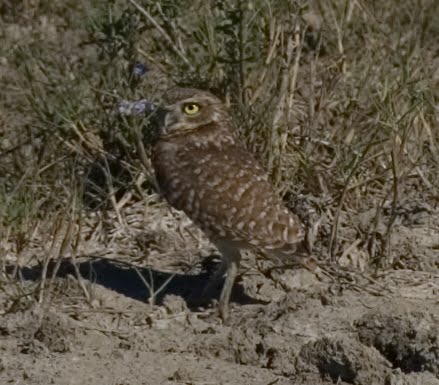
Burrowing Owl


Burrowing Owls are primarily owls of prairie dog towns. In the winter, they migrate south and look for flat fields with some sort of burrow or debris heap they can take shelter in. These owls are somewhat diurnal, especially on overcast days.

I recall the first time I saw a Burrowing Owl. I was walking levees on my uncle's farm near Kaplan when a small pale brown bird flew out of a little concrete culvert. It flew low to the ground, pulled up on a clod a few yards away, and started to bob up and down and swivel its head back and forth. I was amazed to find one of these birds (that I'd only ever seen on nature shows) in the rice country of SW LA. Over the years, I found that coverts on levees in dry fields were good places to look for these owls. I recall finding 2 or 3 in such settings in the winter of 1979 alone.

Since then, Burrowing Owls have become much harder to find in Louisiana. Now, in a good year, 2 or 3 might be found across the entire state. This individual was found in the greater metropolitan Holly Beach area earlier this month, and was still present as of December 19th.

Franklin's Gulls


One of the quiet highlights of fall migration is picking Franklin's Gulls out of Laughing Gull flocks. Franklin's Gulls are small gulls that nest on the North American prairies and spend their winters in South America. Their migration path takes most Franklin's through Texas, but a small percentage of the species often meanders a bit off course, which accounts for the individuals we see in Louisiana. Usually, one or two Franklin's can be found in a day of coastal birding from October through late November or early December. Sometimes, hundreds can be encountered.

Franklin's Gulls can be picked out from Laughing Gulls by their smaller size, by the darker, more complete traces of the black hood of summer, and by their smaller, more delicate bills. There are also difference in wing and tail pattern that aren't visible in this video clip.

This bird was on Holly Beach in late November.

Geese


A flock of geese putting down in a cut ricefield near Kaplan.