Sunday, April 14, 2013

Papabotte

When I was a kid, these birds were known as Upland Plovers.  Now they go by the name of Upland Sandpiper, but if you take a closer look you'll get the sense that they're really just curlews with straight bills.  The local name for them was Papabotte, an onomatopoetic attempt at their weird Wood Thrush-like call.  I'm sure the Mound Builders, the Tchefuncte, the Mandans, and the Attakapas had their own names for this beautiful little bird that either paid them a visit along their migration route, or nested among them on the endless prairies.    

Despite the sandpiper name, this is a grassland bird.  Probably wildly numerous when prairie stretched unbroken up the middle of North America, the day the plow met the Great Plains was a sad day for this species.  Unlike the Rocky Mountain Locust and the Eskimo Curlew, however, Uplands were lucky enough to survive.  In Louisiana, we find them as migrants in early spring and late summer, usually in short grass settings.  They rock their heads forward and back as they pick their way along, or hold still and hope to blend in to dirt or dry grass backgrounds.


It being April, the bird you see here is on its way north, having spent most of the year on the pampas of South America.  Let's hope it makes it where it's going, and makes it back in August with some of its brood along for the long trip south.    
 

Monday, April 8, 2013

Coming Soon to a Town Near You?

Last summer, Dave Patton noticed a pair of Cave Swallows going under a bridge in Lafayette.  That sighting was a first for Cave Swallow in Lafayette Parish, and another sign that Cave Swallows are continuing their northeastward march across Louisiana.

Dave and I have both visited the Lafayette nest site over the past few weeks with no sign of Cave Swallows.  Yesterday, however, I stopped and waited for a few minutes and was rewarded with a nice group of Caves.  There were 7 of them, I think.


The birds seemed pretty serious about nesting.  In addition to disappearing under the bridge for short periods of time, the birds were engaged in what appeared to be aerial courtship or competition.


At times, their maneuvering reminded me of Chimney Swifts in flight.  


It's amazing to think that Cave Swallows have gained a foothold so close to home that I can drive 5 minutes and get my fix.  If this colony persists, there's no shortage of similar sites nearby.  Soon, instead of living on the edge of known Cave Swallow range, we might find ourselves well behind the front line of their range expansion.  


Monday, April 1, 2013

Cameron Parish, 4/1/13

Following a night with rain, there was good action along the coast today.  Most of the yellowrumps were gone, replaced by about 15 Hooded Warblers, the same number of Black-and-white Warblers, around 30 White-eyed Vireos, and a small number of other migrants.  My warbler total for the day was 11 species.


Robby Bacon kicked up a nighthawk that proved to be a Lesser Nighthawk.


 Other good sightings were the legendary Melvin Weber and Ron Stein.

Tuesday, March 26, 2013

Wednesday, March 20, 2013

Louisiana list now at 479


The official Louisiana State List now stands at 479 species after the latest meeting of the Louisiana Bird Records Committee.  The additions to the list were Pacific Loon, Mountain Plover, Iceland Gull, Razorbill, and Dusky-capped Flycatcher.  

The addition of Iceland Gull was a long time in coming, and it’s possible that despite its addition, the State List will eventually lose a bird.  Iceland Gull as currently recognized is made up of two subspecies, known as “Iceland Gull” and “Kumlien’s Gull.”  Some ornithologists believe that the similar Thayer’s Gull – which is already on the Louisiana list – isn’t a true species at all, just another subspecies of Iceland Gull.  If that belief ever creeps into the AOU Checklist, the Louisiana list will keep Iceland Gull, but lose Thayer’s Gull.   On another hand, some ornithologists think that Thayer’s Gull and the “Iceland Gull” subspecies of Iceland Gull are both true species, while Kumlien’s Gull is just a hybrid of the two.  If that scenario ever hits the checklist, we would keep Thayer's Gull but lose Iceland Gull (because our Louisiana Iceland Gulls thus far have probably all been Kumlien’s Gulls).  Confusing, eh?  

Until this winter, Razorbill wasn’t viewed as a real possibility to be seen in Louisiana.  However, an unprecedented surge of Razorbills flooded the Atlantic Coast, wrapped around the tip of Florida, and headed west along the Gulf Coast.  At least one made it to our state. 

The other species were all expected to some degree, with Mountain Plover and Pacific Loon considered long overdue.  Dusky-capped Flycatcher records have been inching toward us over the past few years, but the North Louisiana record was a pretty good jump for the species.

Another vote of note at the LBRC meeting involved a potential first state record, a report of a Slaty-backed Gull that I had submitted.  The record was rejected, as some members had legitimate concerns about adding a gull species to the State List on the basis of a sub-adult individual in a less-than-straightforward plumage.   While I supported the record, I was comfortable with the result as it was in keeping with the tradition of the Louisiana State List as overseen in the past century by Oberholser and Lowery.  As Lowery stated in Louisiana Birds, “Scientific data of any sort must be subject to the closest scrutiny and to the most rigid tests of their validity.  Science is truth.  When we seek the truth, we must always demand unimpeachable evidence.”

Three other species, Parasitic Jaeger, Allen's Hummingbird, and Western Tanager were removed from the Review List.  The first species has been recorded with some frequency by Dave Patton on his boat trips out of the mouth of the Calcasieu into the Gulf (which also resulted in the Razorbill record).  Allen’s Hummingbird is still an ID problem, but it occurs in too large of numbers to be considered rare any longer.  Western Tanager is fairly well detected because of its size and color, and finding one will always provide a thrill regardless of its status.   

Monday, January 28, 2013


Sandhill Cranes

I remember getting a strange call from Dave Patton one day about 20 years ago.  He called to say that a family group of Sandhill Cranes had dropped down in a big open field off of Congress Street in the middle of Lafayette.  At the time, seeing a Sandhill Crane anywhere in southwestern Louisiana was an odd surprise, but seeing a group feeding between the Cajundome and the Wetlands Research Center with a backdrop of passing traffic was just absurd.  We stood at wondered at them until they jumped up, circled up into the wind, and sailed away.  

That crane field now hosts a Hilton Hotel, but the fate of Sandhill Cranes in the area has improved in amazing fashion.  In the past few years, Sandhill Cranes have staked a major claim on this part of the state.  What was once a small flock hidden away among the winter fields of Calcasieu Parish's Holmwood area has grown into a presence of thousands of birds, and smaller groups can be found in the surrounding parishes.  Even western Lafayette Parish hosts a small flock.  Let's hope this trend continues and these cranes become a permanent and visible presence in our corner of the state.    

The pictures below were taken last weekend near the town of Iowa.  


Monday, January 21, 2013

Yard Hummers.

Couldn't get much birding in this weekend, but I did spend a bit of time in the backyard today.  Yard birds were very active, with goldfinches poking around everywhere looking for some seeds.  

The hummingbirds were especially noticeable.  Some guests that were visiting got buzzed by a Broad-tailed Hummingbird that dropped in and fed within a foot of them.  

I took advantage of the activity and tameness to snap a few photos:

One of at least 2 Rufous Hummingbirds present, both immature males.


One of several Black-chinneds that have been present at times during this winter.  


Broad-tailed Hummingbird.  This young male has been around for a couple of weeks.  


Sunday, January 20, 2013

Offshore Cameron, 1/19/2012

Click pictures to enlarge

I joined up with Dave Patton, Danny Dobbs, and Mac Myers yesterday for a boat trip out of Cameron into the near-shore gulf.  Dave has a nice boat that's big enough to go a few miles out when there's a little bit of a swell, but small enough to maneuver along the rock jetties leading out of the ship channel.  We check the rocks on both sides of the jetty every time out in hopes of finding good shorebirds or gulls, but the truth of the matter is that Dave has one thing on his mind when he hits the water, and that's jaegers.

On the way out, I noticed a major dropoff in bird numbers from those of previous trips.  There were few shorebirds on the rocks, few gulls and terns roosting on the shell bars, and not much in terms of birds over the gulf itself.  

Dave's trick for finding jaegers is to look for the crowds of birds that follow shrimp boats, but the only shrimp boat we saw was tied idle to a rig.  We saw a small group of birds following a crewboat in, so we headed toward it.  As it passed, we saw two jaegers accompanying the group back toward the ship channel.  We continued on out offshore.  

By this point, we weren't seeing any birds.  This was a bad situation because jaegers are attracted to flocks of the feeding gulls they rob for food--over even kill and eat--and without gulls, we'd have to be lucky to find jaegers. There were a few Royal Terns, but even Laughing Gulls were absent. Eventually a Laughing Gull passed and Dave tossed out a handful of popcorn.  The bird banked and dropped in for the food. Within minutes, keen-eyed gulls from the distance had spotted the activity and made it to the boat.  Clearly these birds were hungry, maybe even starving at this time of year.  

Then, a jaeger appeared.  We were expecting a quick passby and maybe the chance to snap off a few quick pictures.  It zoomed by...


then came closer...


and turned and saw the popcorn...


and settled onto the water.  


And then another jaeger came, and another.  Soon there were 6 Pomarine Jaegers sitting on the water around us and buzzing us for popcorn.  


They were as wild and untamed as only jaegers can be, real cold-eyed killers:


With their noble, savage crops full of popcorn.


From there, we hit the rocks again, and got great looks at American Oystercatchers.


Then we headed back out to look for more jaegers.

We built up a little flock of gulls, but no jaegers seemed interested.  Then Dave saw a group of gulls following the churned-up wake of a passing boat, and we motored toward it.  As the birds passed, Dave offered them some popcorn, and soon we had a great flock feeding around us.  The jaegers that we saw out here weren't very cooperative, just passing by.


But we did pick up a California Gull...


as well as this pale-winged gull that seems best for a Kumlien's/Thayer's Gull:


It was a great day on the water. The weather, the birds, and the company were all top notch.  A big thanks to Dave Patton!

Saturday, January 5, 2013

Duck Redux


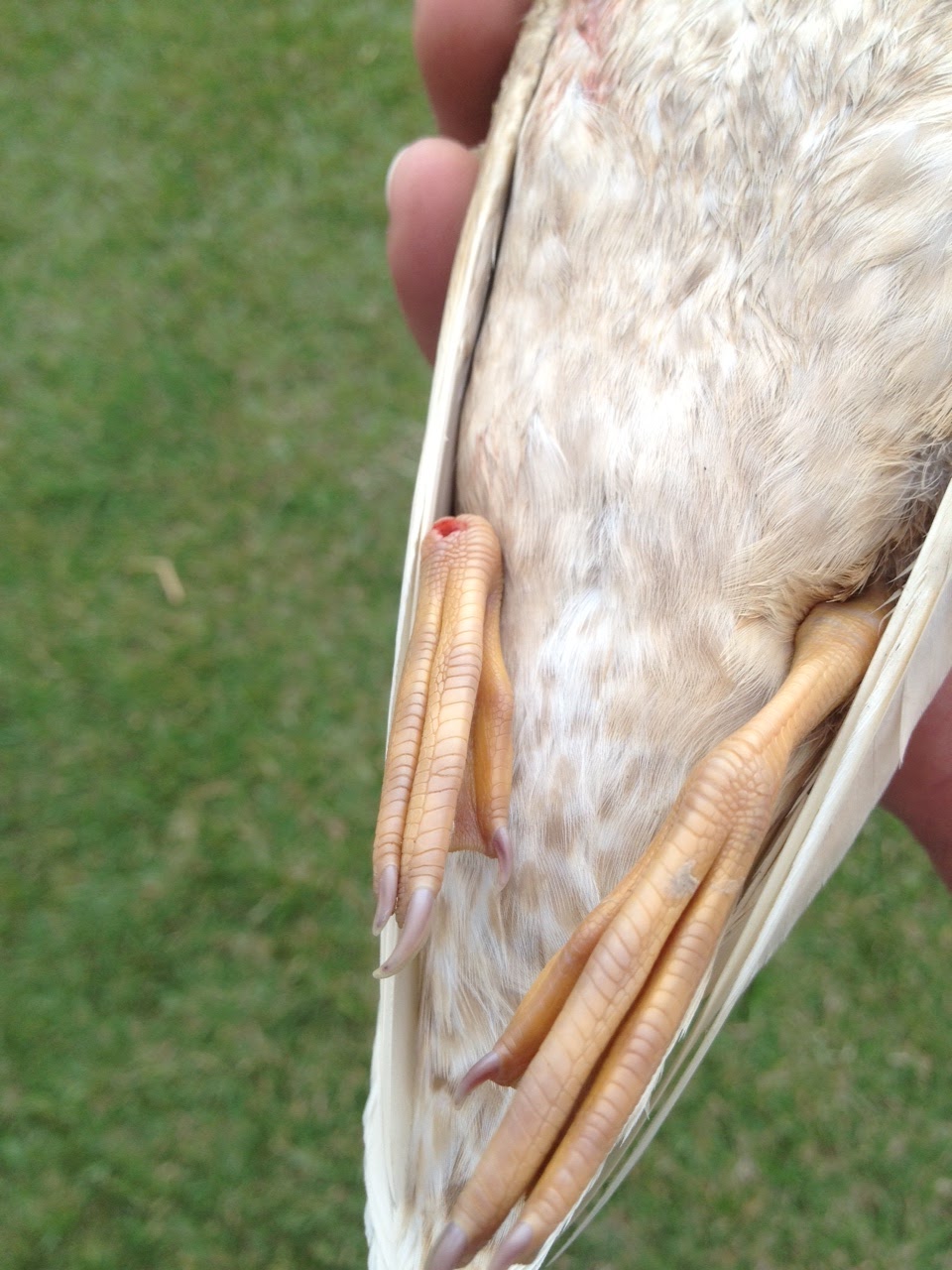
A couple of weeks ago, I posted photos of a mocha-colored Blue-winged Teal from the Kaplan area, seen on 12/15.


A few days later I noticed a comment attached to the post:


 Anonymous said...
My buddy killed a teal on 12/16/12 Northwest of Church Point, LA. I stumbled across your picture and was wondering if this could be the same duck since you posted this on the 15th. they look identical. I tried to post a picture here, but it would not let me. If you would like to see it, you can send me your email address and I will reply with a picture.
fhhanley@yahoo.com

I wrote back, and received this reply and these photos:  

These are the pictures of the teal that my pal took with his Iphone, so please pardon the not-so-professional photos. I looked around on the net and truly enjoyed the detailed photos that you took of our LA wildlife. 

He already has it at the taxidermy and is chomping at the bit to get it back so he can showcase his rare kill. This would be amazing if it was the same bird!! They really do look similar from the pictures. Thank you for responding and I hope this will make a good story for you to tell one day.

Frank Hanley
Church Point


A very close resemblance.  Note the similar location of the darker feathers on the mantle in both photos.  While I'm not amazed if this duck flew from Kaplan to Church Point in one day (which is nothing for a duck), if it's the same duck I find it amazing that it crossed paths with two humans in two days.  I also find it amazing that someone found the picture on my site.  That's one serendipitous duck.   
It's a memorable bag, and it must have been an exciting retrieve.  Congrats to the hunter, and thanks to Frank for everything!