Friday, November 23, 2012

Jeff Davis Parish, 11/23/2012

I took a drive to unwind and listen to the Tigers game today.  I headed west to the Lacassine exit off of I-10 in Jefferson Davis Parish.  

First I went north, but got turned around by rain.  Near the turf farm on Turf Grass Road, I had a couple of good sightings.  The cottonmouth may have been moving ahead of the cold weather.  The Long-billed Curlew is a good bird to find inland, and is just plain a cool bird.  


I headed south and then west, toward Lake Arthur.  East of Thornwell I found a couple of tractors busting up plowed soil, shooting huge sheets of dust into the air.  Apparently, this was pretty attractive to hawks, because the field was full of them.

There were 11 Swainson's Hawks there at least, which is pretty odd for this time of year.


There was also a Ferruginous Hawk in the field, as well as a couple of Red-tailed Hawks.  Quite a nice field full of hawks.  


Sunday, November 18, 2012

A few recent photos

Dark Red-tailed Hawk, I assume a "Harlan's."  

Young "Harlan's" Red-tailed Hawk.  This bird was in a group of 31
Red-tailed  Hawks over a field that was being plowed
today in Jeff  Davis Parish.

Marsh Hawk, a.k.a. Northern Harrier

Swainson's Hawk, Cameron Parish, 11/11/12

Sprague's Pipit, Acadia Parish, 11/17/12

Sunday, November 11, 2012

Western Accent

There was a bit of a western flavor to today's birding in Cameron Parish.  I was down with Dave Patton, Mac Myers, and David Muth.  Among the birds we saw were Calliope Hummingbird (found by Dave Patton), Spotted Towhee (below), Western Tanager (below), Say's Phoebe, possible Townsend's Warbler seen by Mac Myers, plus more regular westerners like Swainson's Hawk, and Franklin's Gull. 

Conditions started off as horrible but improved to pretty bad as the day went on.  Gusting south winds and morning rain gave way to steady but manageable winds, then steady rain late in the day.


Spotted Towhee, Peveto Sanctuary (found by David Muth)

Western Tanager, Peveto Sanctuary (found by David Muth)
Say's Phoebe, near Willow Island (stakeout)

Tuesday, October 16, 2012

Cameron 10/16

Olive-sided Flycatcher

Buff-breasted Sandpiper

My son returning to Earth after 24 mile free-fall at Mach 1.24. 

Sunday, July 15, 2012

Leech

With all of the recent rains, pastures are flooding and flooded fields are overflowing.  Ditches are full, and some roads are getting covered with water.  On a flooded road shoulder today, I saw this leech working its way along through the water.  I scooped it into an Icee cup (the pink stain in the water is strawberry, not blood).  I wanted to bring it home to watch it, but I realized I'd need to find something to feed it.  There's not really a lot of blood in the fridge, so I decided to let it go.


Thursday, July 5, 2012

Cool Birds, Hot Boudin

A few quick notes and photos.

Yesterday I took a non-Atlas trip to the Gueydan area to study swallows.  I was hoping to look at young Cliff and Cave swallows to see how much room for confusion there is with the pair, and to look for clues for how to sort them out if they can and do look alike.

But funny things happen when you're trying to put the blinders on.

Among the swallows was a Bank Swallow that hadn't been recorded yet for the Gueydan Quad.


That meant I should spend an hour counting birds in the Gueydan Quad.  I was driving away from the swallow spot when I noticed a wet field along the highway.  In it were shorebirds, which the Gueydan Quad also needs.  And among the shorebirds there were two godwits, a Marbled and a Hudsonian.


These are probably the same godwits Steve Cardiff and Donna Dittmann found a few miles to the west last week.  Wet fields dry up quickly in summer, and when they do, birds move on.

Gueydan Quad:  10+ hours.  

This morning I headed to the Fenton Quad to put the final hours in on it.  It was tremendously birdy.  A Common Ground Dove flew up off a roadside and started singing.


Storks and other waders filled up flooded fields.


And there were swallows everywhere.  Caves and Cliffs, Barns, and young of all three.


Juvenile Cave Swallow


Adult Cave Swallow

Juvenile Cliff Swallow


Fenton Quad:  10+ hours.  


Next I found myself in lovely Iowa, Louisiana.


And, lo and behold!  It was time to eat.  Of course, when boudin is on the menu, it's always time to eat.


I parked between the lines, and porked out.


Pretty decent boudin.  I'd had Rabideaux's before, but this was better than I remembered.  Good flavor, good texture, nothing bad about it.  I added salt, of course.

The Iowa Quad wasn't quite as good.  The most interesting part for me was hearing Gray Catbirds singing.  I don't get to hear catbirds very often.  I had four catbirds, and every one of them had incorporated the caw of a crow into its song.  Do they often do that, or are the Iowa catbirds really talented?  Whatever the case, it was a perfect imitation.

I also got to hear a Bobwhite giving wacked out calls from a perch in a short monglier shrub.

Iowa is a good area for Scissor-tailed Flycatchers, too.


And this Common Nighthawk was kind enough to fly around and land where I could get a photo.


Tuesday, July 3, 2012

Dusty Old Dust, 7/3/12

I spent some time out around beautiful Gueydan today.  As the day got hotter, I started seeing white columns rising from the horizon in every direction I looked.  I thought they were hot fires making white smoke.  Some were distant bright lines that I could have passed off as my imagination or as the beginning symptom of some kind of heat illness.  Others seemed closer and were definitely real.  As I moved from an area of green fields to one of plowed fields, the columns began to pop up in spirals right in front of me.  They were what I called "dust devils" when I was a kid, little tornadoes of dust rising quickly over hot bare fields.

The dust devils started as puffs of smoke, and eventually built up like the smoke rising from a growing fire.  A few then died down while others rose high into the air to form thin tight spirals, kind of like waterspouts but on dry, hot land.  As I scanned the horizon I could see dozens at any given time, some near and some farther off.

Here's a brief clip of a short, shaky scan of the horizon.  I hope it gives an idea of the scope of the setting.  I also hope these fields got as much rain this afternoon as Lafayette did.  They needed it.


Saturday, June 30, 2012

Bayou Vermilion, Vermilion Parish. 6/29/2012.

Yesterday, I had a great day on the water courtesy of Dave Patton.  Dave took his boat out to survey the birds around Intracoastal City.  I.C. is an entry point for several waterways, including the Intracoastal Canal and Bayou Vermilion.

As a resident of Lafayette, I know Bayou Vermilion as a sleepy bayou lined with nice houses and immaculate yards.  On the south end of town, the bayouside becomes more natural, the houses blend into nature a bit more, and the bayou heads down toward Abbeville.  Yesterday, I got a different look at Bayou Vermilion altogether.  

Intracoastal City is south of Abbeville, and the stretch of the bayou between Abbeville and Intracoastal was something I'd never seen.  We headed out of Intracoastal City in the boat, and turned north into the bayou.  Intracoastal City is on the edge of the marsh, without much in the way of trees along the waterways around the launch.  A short way upriver, near where the "pogey plant" processes Gulf Menhaden (fish), things started to change.  Cypress trees began to appear, and the banks of the bayou became lined by hardwood forests.  We headed farther north through thick forests that made me wonder if this is what the bayou looked like when my ancestors first saw it over 200 years ago.  


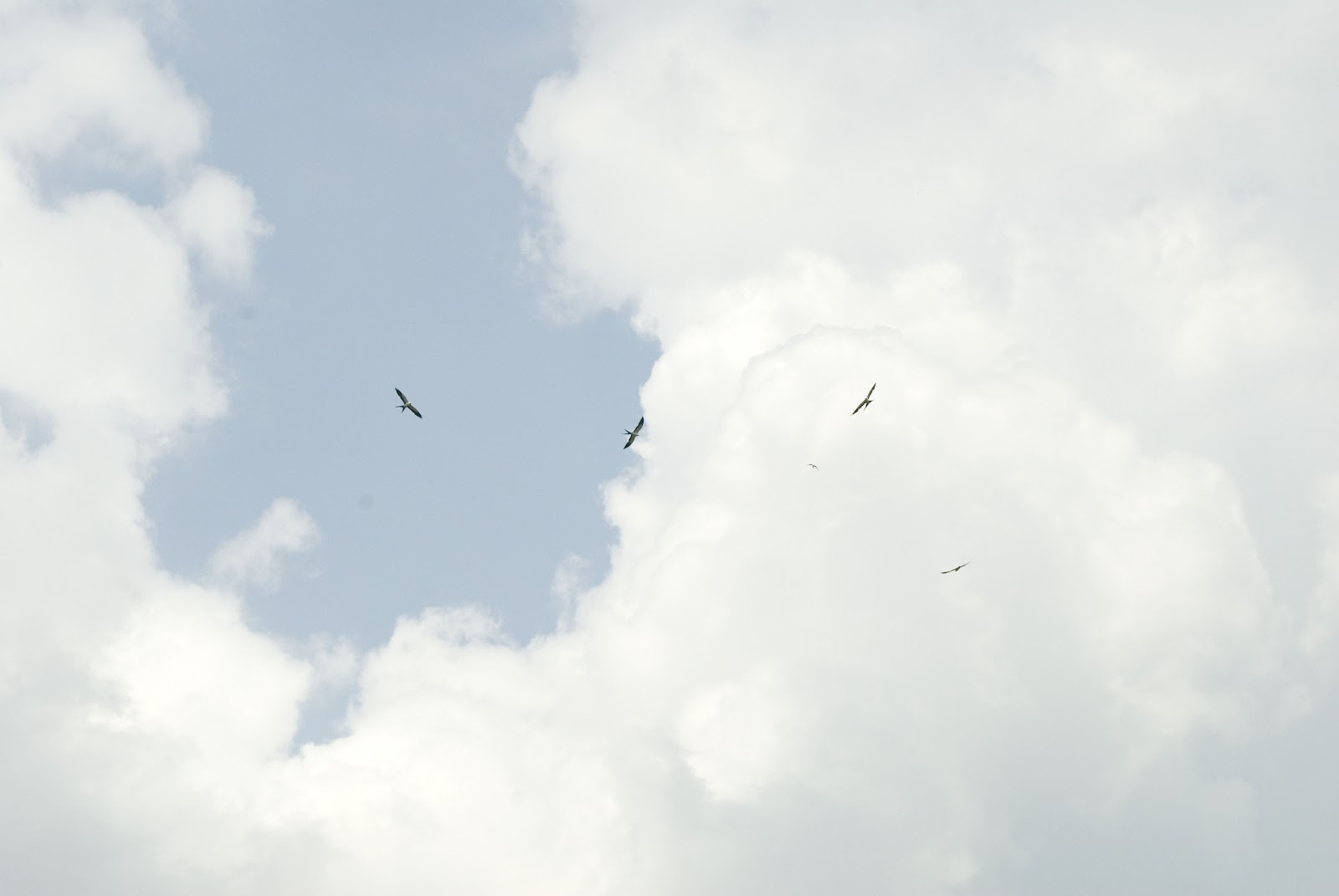
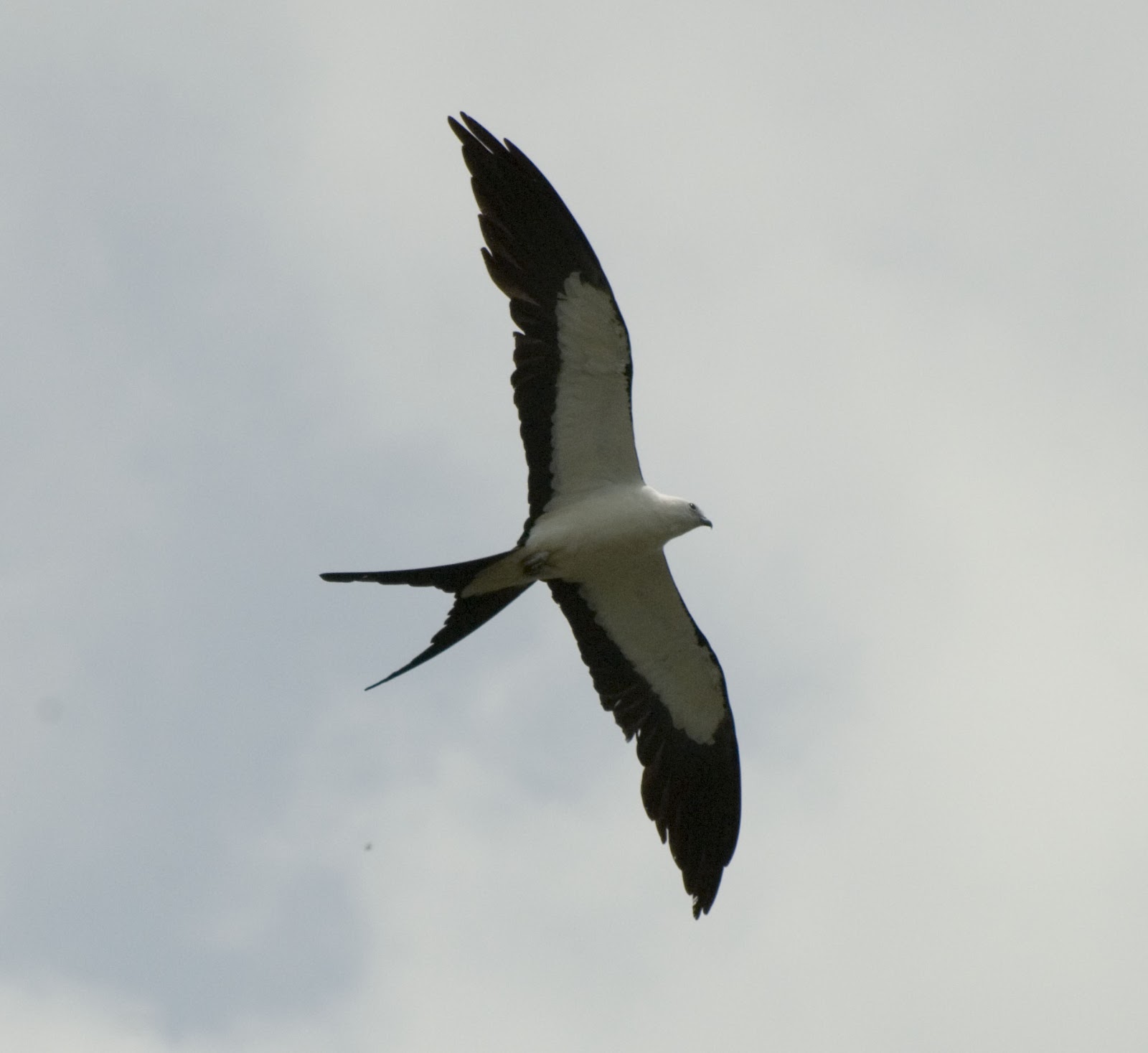
After a while, the sense of wildness became a little more pronounced when we spotted Swallow-tailed Kites circling in the thermals above.  


As we slowly worked the channels leading into the bayou, the kites came lower. 


It's hard not to marvel at Swallow-tailed Kites.  Everything about them is remarkable.  They can glide effortlessly, turn in midair, dive at lightning speed, and then swoop back into a lazy, unhurried glide--all within seconds.  And they do it for hour after hour.  They seem to delight in flying.  And when they do flap, it's also slow and unhurried.  They make defying gravity look easy.  

We noticed that one of the kites was carrying something in its talons.  We realized later it was a paper wasp nest, which I'm told is something they like to eat the larvae from.  The nest was the object of several chases, but some of the chases we saw seemed to be nothing more than a game.


We were able to enjoy the kites all the way back to Intracoastal City.  At times, the kites flew below the level of the trees and gave us excellent views.  The most we saw together at one time was eight birds, although there might have been more.    


When we came out of the woods, I had to remind myself that all of this happened just a short drive from Lafayette.  This stretch of Bayou Vermilion is a treasure, and I hope it stays that way forever.  

If you don't have a friend with a boat, another way to enjoy the area is by visiting Palmetto State Park.  We docked there for a few minutes, and it's a first class facility.  Their website is: http://www.crt.state.la.us/parks/ipalmetto.ASPX

Wednesday, June 27, 2012

Recent Pictures from Vermilion Parish Trips

Shorebirds are already on their way back from the breeding 
grounds, although the plain-looking Black-bellied Plover in
the front may have been a local summerer.  

Cave Swallow from a colony near Gueydan

White-tailed Deer from the Gueydan area.  

Cave Swallows (plus one Barn Swallow) from the Mulvey
area.  

A few views, here and below, of young Cave Swallows.  


Sunday, June 10, 2012

Texas Point Quad,

I had a free day yesterday, so I decided to head down to the coast to check out the general conditions.  My two main areas of curiosity were the gull and tern flocks on the beaches, and the possibilities of shorebirds in a few areas where there had been some a few weeks ago.  
The beach was crowded with humans.  Many of the beach campsites were flying rebel flags and were attended by pit bulls.  That's not my demographic, and the flags appeared to have frightened away everything but winter-plumaged Sanderlings, so I continued west.  
Texas Point, the area all the way to the SW corner of the state, was my next destination.  I knew there'd been good numbers of shorebirds there in May, and I wanted to see if any remained.  We're currently in the atlas period for the Louisiana Summer Bird Atlas (see http://www.museum.lsu.edu/~Remsen/SummerBirdAtlas.html and http://ebird.org/content/la/about ), and I thought there might be some species present that are generally hard to find at this time if for no other reason than lack of habitat.  
I found the following shorebirds, plus a few others.  
Stilt Sandpipers; I tallied 19.
White-rumped Sandpiper; 42.  
Wilson's Phalarope; 4.

Western Sandpiper; 2. 

The Westerns were the biggest surprise to me.  I've seen them in "fall" migration as early as late June, but not as early as June 9.  There's no telling if these are early migrants, but given the plumage, that's my guess.  

Wilson's Phalaropes sometimes show up early on their return trip south, but these I think are a bit too early.   I'm guessing they're holdovers from the large flock that frequented this area over the past month.  One of them had a badly injured leg, which would seem to support that idea.

Next week, I'll start hitting quads in the interior.